Daniel posted a recipe a while back, and that's basically the one I used, if any. I added about two tablespoons of chicken liver paté to the mixture, remembering a commenter recommending it, and they turned out really juicy and, if that's even possible, meatier than normal. I ate the meatballs with mashed potatoes and our homemade lingonberry jam, and drank a glass of cold milk. It just doesn't get any more Swedish than that!
Showing posts with label Swedish. Show all posts
Monday, December 1, 2008
Classically Swedish
The snow has melted away, and the temperatures have risen. The evenings still get a bit chilly, though, and that calls for hearty and warming food. Again, one tires of porridge, so I thought I'd make some meatballs.

Daniel posted a recipe a while back, and that's basically the one I used, if any. I added about two tablespoons of chicken liver paté to the mixture, remembering a commenter recommending it, and they turned out really juicy and, if that's even possible, meatier than normal. I ate the meatballs with mashed potatoes and our homemade lingonberry jam, and drank a glass of cold milk. It just doesn't get any more Swedish than that!
Wednesday, September 3, 2008
Pan-fried Herring on Crisp Bread
Herring has been an important staple of Swedish cooking for a very long time. The Swedish working class used to subsist almost exclusively on salted herring and potatoes, with the occasional pickled herring when it was party time. Due to its importance, herring holds a special place in the food culture of Sweden. This recipe is one of the most beloved, but luckily also one of the simplest. If you're ever in Stockholm, you can buy these sandwiches at the square by Slussen. The only tricky part about the recipe is finding the right type of herring. Or perhaps, finding herring at all, depending on where you live.
You see, herring comes in many styles, depending on its origin. The version used here is the smaller and leaner Baltic herring (the subspecies Clupea harengus membras), fished in the Baltic sea off the east cost of Sweden. This type of herring is known as strömming in Swedish, while the larger and fatter herring used for pickling is called sill.
Pan-fried herring on crisp bread
If you prefer, you could serve these with mashed potatoes and a sour cream dip, but do try them with crisp bread at least once. If you have a hard time finding decent crisp bread, try IKEA, who usually carry crisp bread from Leksand. Avoid Wasa if alternatives exist.
1 kg of fresh herring fillets
a large bunch of parsley
bread crumbs
Remove the back fins from the fillets, if present, wipe them dry with kitchen towels, then match them up in pairs of roughly equal size.
Chop the parsley, and place a generous amount between each pair of fillets. As you can see, frozen parsley is fine too.
Pour bread crumbs on a plate and coat each fillet pair with a generous amount of crumbs.
Get your local nationalist butter...
...and place a big knob of it in a hot skillet.
Then fry the fillets for a few minutes on each side, until golden brown.
Now get your best crisp bread. This particular brand is produced in a community of treehuggers in Järna, south of Stockholm. They also sell their own flour, beans and lentils, all of which is great produce.
Spread some butter on the bread, place a couple of fried fillets on it, and you're done! Serve with a cool beer or a glass of cold milk.
Friday, July 4, 2008
Swedish Meat Balls (Köttbullar)
Returning to the theme of Swedish home cooking, today we take a look at Köttbullar, the Swedish meat balls. These tasty little balls (god I love saying that, please don't hate me for it) are mandatory on the Christmas smörgåsbord, and are served as a quick everyday dish in homes all over that oblong country called Sweden. They were always rather well known abroad, but IKEA has brought them to tables in their warehouses all over the world, ensuring that people everywhere have a chance to try them.
The only sad thing about this story is that IKEA's meat balls just aren't that good. They're decent, but they belong in the category of pre-made, frozen and reheated meat balls that my family affectionately calls "bouncing balls" (studsbullar), due to their rubbery texture. The home made version is another dish entirely, and belongs in the category of simple home cooking that brings you back to your childhood, where your mother served you this perfect comfort food.
Mothers, yes. More or less every mother in Sweden has her own meat balls recipe, and the term mammas köttbullar (mom's meat balls) is used to denote anything with that real emotional aspect to it: nobody makes meat balls like your own mother. Me, I'm not a mother, nor am I likely ever to be, but since November 2007, I am an uncle, so I guess my meat balls are morbrors köttbullar (uncle's meat balls) instead. Not that my little nephew Henning has tasted them, but maybe he will one day.
Morbrors köttbullar
The problem with ground meat is that it can easily get a boring, dry texture and swell in your mouth in a nasty sort of way. To avoid this, generations of Swedish mothers have added breadcrumbs soaked in water or milk to moisten the mixture, and eggs to bind it together. I use heavy cream instead, and I advise you to do the same, the difference in taste is bigger than the difference in fat content. Another trick to help keep the meat balls juicy is to use a 50-50 mixture of ground beef and ground pork.
Like most traditional Swedish dishes, meat balls are seasoned very lightly, the recipes calling only for onions, salt and white pepper. I like to add a bit of tabasco to give them a sort of background heat, without actually tasting of chili, but that's optional. Most people put the onion through a fine grater to create onion mush, while I prefer to chop it. Chopping it gives you little pieces of onion ingrained in the meat, which I think gives a better texture, but it does make the balls a bit more brittle.
This recipe is the usual amount that I make for 2 people, but it probably serves 3-4 adults, especially if you add a salad and dessert to the meal.
Ingredients
500 g of ground meat, preferably 250 g each of ground beef and pork
1 onion
2 Tbsp of bread crumbs
3-5 Tbsp of heavy cream
1 large egg
salt
white pepper
(5-7 dashes of tabasco)
Instructions
Put the bread crumbs in a bowl large enough to mix all the ingredients, and cover with the cream. Let sit for 5-10 minutes to let the bread crumbs absorb the cream. Rather finely chop (or finely grate) the onion and add it and the egg, some salt, pepper and the tabasco to the crumbs and mix.

Something along these lines. Not too bad looking with the red onion, but please ignore the dirty pot in the background. It's one of those perks of sharing a kitchen with 11 students.
Mix in the ground meat, massaging the mixture until it goes smooth. If it feels grainy, add a little more cream. Season with salt and pepper to taste. This last step can be hard if you're squeamish about tasting raw ground meat, which I am not, but unfortunately, I don't know the amount of salt and pepper necessary; I taste my way to it.

Your mixture should look something like this when amateurely photographed in heavy backlight.
Wash your hands off, and rinse them with cold water. Grab pieces of the mixture and roll them between your hands into meat balls, about 2-3 cm across. Place them on a slightly moist cutting board.

When all the balls have been rolled, heat a generous amount of butter in a skillet (preferably cast iron), and give the balls a nice browning on high heat, then lower to low to medium heat and fry them evenly (just shake the pan, they should roll around nicely) for about 5-10 minutes. You'll probably need two frying pans, or to fry them in batches. When you think they're nearing completion, try one. The ideal is that it should have just a little hint of pink in the middle, and drip juices when you cut into it. Don't overcook them: nobody likes them tough and dry.

Alright, that's it! To serve traditionally, boil some potatoes, and make a sauce by deglazing the skillet with some water and then add some cream or milk, a little bit of starch to thicken, and some soy to give a nice color. Serve the meat balls with the potatoes and sauce, some lingonberry jam and perhaps pickled cucumbers.

We made these for our midsummer's supper, so here's a picture of the finished meatballs along with some other traditional Swedish midsummer's food: pickled herring with sour cream and boiled eggs, beer and spiced vodka (snaps).
The only sad thing about this story is that IKEA's meat balls just aren't that good. They're decent, but they belong in the category of pre-made, frozen and reheated meat balls that my family affectionately calls "bouncing balls" (studsbullar), due to their rubbery texture. The home made version is another dish entirely, and belongs in the category of simple home cooking that brings you back to your childhood, where your mother served you this perfect comfort food.
Mothers, yes. More or less every mother in Sweden has her own meat balls recipe, and the term mammas köttbullar (mom's meat balls) is used to denote anything with that real emotional aspect to it: nobody makes meat balls like your own mother. Me, I'm not a mother, nor am I likely ever to be, but since November 2007, I am an uncle, so I guess my meat balls are morbrors köttbullar (uncle's meat balls) instead. Not that my little nephew Henning has tasted them, but maybe he will one day.
Morbrors köttbullar
The problem with ground meat is that it can easily get a boring, dry texture and swell in your mouth in a nasty sort of way. To avoid this, generations of Swedish mothers have added breadcrumbs soaked in water or milk to moisten the mixture, and eggs to bind it together. I use heavy cream instead, and I advise you to do the same, the difference in taste is bigger than the difference in fat content. Another trick to help keep the meat balls juicy is to use a 50-50 mixture of ground beef and ground pork.
Like most traditional Swedish dishes, meat balls are seasoned very lightly, the recipes calling only for onions, salt and white pepper. I like to add a bit of tabasco to give them a sort of background heat, without actually tasting of chili, but that's optional. Most people put the onion through a fine grater to create onion mush, while I prefer to chop it. Chopping it gives you little pieces of onion ingrained in the meat, which I think gives a better texture, but it does make the balls a bit more brittle.
This recipe is the usual amount that I make for 2 people, but it probably serves 3-4 adults, especially if you add a salad and dessert to the meal.
Ingredients
500 g of ground meat, preferably 250 g each of ground beef and pork
1 onion
2 Tbsp of bread crumbs
3-5 Tbsp of heavy cream
1 large egg
salt
white pepper
(5-7 dashes of tabasco)
Instructions
Put the bread crumbs in a bowl large enough to mix all the ingredients, and cover with the cream. Let sit for 5-10 minutes to let the bread crumbs absorb the cream. Rather finely chop (or finely grate) the onion and add it and the egg, some salt, pepper and the tabasco to the crumbs and mix.
Something along these lines. Not too bad looking with the red onion, but please ignore the dirty pot in the background. It's one of those perks of sharing a kitchen with 11 students.
Mix in the ground meat, massaging the mixture until it goes smooth. If it feels grainy, add a little more cream. Season with salt and pepper to taste. This last step can be hard if you're squeamish about tasting raw ground meat, which I am not, but unfortunately, I don't know the amount of salt and pepper necessary; I taste my way to it.
Your mixture should look something like this when amateurely photographed in heavy backlight.
Wash your hands off, and rinse them with cold water. Grab pieces of the mixture and roll them between your hands into meat balls, about 2-3 cm across. Place them on a slightly moist cutting board.
When all the balls have been rolled, heat a generous amount of butter in a skillet (preferably cast iron), and give the balls a nice browning on high heat, then lower to low to medium heat and fry them evenly (just shake the pan, they should roll around nicely) for about 5-10 minutes. You'll probably need two frying pans, or to fry them in batches. When you think they're nearing completion, try one. The ideal is that it should have just a little hint of pink in the middle, and drip juices when you cut into it. Don't overcook them: nobody likes them tough and dry.
Alright, that's it! To serve traditionally, boil some potatoes, and make a sauce by deglazing the skillet with some water and then add some cream or milk, a little bit of starch to thicken, and some soy to give a nice color. Serve the meat balls with the potatoes and sauce, some lingonberry jam and perhaps pickled cucumbers.
We made these for our midsummer's supper, so here's a picture of the finished meatballs along with some other traditional Swedish midsummer's food: pickled herring with sour cream and boiled eggs, beer and spiced vodka (snaps).
Sunday, June 29, 2008
Cardamom - A Love Affair
I love cardamom. Always have, always will. The smell of it haunts my childhood memories, as do the so-not-plain cardamom buns my mother always made. My mother has taught me a lot of things, but the one thing I will always remember is this: Always use more cardamom than stated in any bun recipe!
Weird thing to remember, right? Well, what can I say--mothers are always right!
The state of supermarkets here in Munich is really quite horrible, and one item you will never be able to find in one is cardamom seeds. Maybe they're not easily available where you live either, but every little corner shop in Sweden sells them. That said, horrible supermarkets does actually come with a few advantages. For example, food- and farmer's markets can be found all over town, and since the supermarkets are so empty, there are quite a few little shops that specialise on, say, spices. We found a great little shop selling only spices quite close to the city centre, and since we wanted to make cinnamon buns, we soon paid them a visit. After having been interviewed for the local TV station doing short interviews at the shop (What are you looking for? Oh, cardamom, what is it for? Oh, cinnamon buns, is that a typical Swedish Easter dessert? No? Okay, bye then.) we found our precious cardamom, and the world made sense again.
Swedish Buns recipe as old as the hills (this particular one comes from Sju sorters kakor). Yields: depends on how big you make them.
Dough
150 g butter
500 ml milk, preferably full-fat and at room temperature
50 g fresh yeast
1/2 tsp salt
150 ml sugar
1 egg
2-3 tsp cardamom seeds, finely ground
1000 g wheat flour
Crumble yeast into a large bowl.
Melt the butter in a small saucepan. Add the milk and stir together. When it has reached 37 C, or body temperature, add a small amount to the yeast and stir until yeast has dissolved. Add the rest of the liquid.
Add the salt, sugar, cardamom, egg and about 800 g of the flour and start kneading the dough, either by hand or machine with dough hooks. Add more flour, little at a time, and knead until the dough is smooth, shiny and does no longer stick to the sides of the bowl. Be careful not to add too much flour--you don't want the dough to be dry, but you also don't want it to be sticky. (I usually knead it mostly using my hands instead of a wooden spoon, since it's easier to tell when to stop adding flour.)
Dust with a little bit of flour, cover with a clean kitchen towel and let rise in a warmish environment for about 40 minutes, or until doubled in size.
In the meantime, make the fillings.
Cardamom and Almond paste
2 tsp cardamom seeds, finely ground
125 g almond paste
50 g butter, at room temperature
Grate the almond paste and mix together with butter and cardamom until smooth and spreadable.
Cinnamon
100 g butter, at room temperature
100 ml sugar
2 tsp ground cinnamon
Mix everything together until spreadable.
Divide the dough into two parts.
For the cinnamon buns, roll out a rectangle about 30 cm x 40 cm and spread the filling evenly. Roll it together, from bottom to top (i.e. at one of the longer sides), cut into equally large pieces and place on a baking sheet.
For the cardamom/almond buns, roll out the dough until it is rather long, and about 20 cm wide. Spread out the filling evenly. Instead of rolling, fold in in half along the long side and cut out strips, about 3-4 cm wide. Make a 3/4 cut from bottom to top, making sure it does not divide entirely. They should sort of look like a pair of legs, ending with a bit of stomach. Spin out each "leg" in opposite directions, and then tie them into a knot. Place on a baking sheet.
Cover with a kitchen towel and let rise for about 30 minutes, or until doubled in size.
Pre-heat the oven to 225 - 250 C / 440 - 480 F.
Whisk together an egg with about a teaspoon of water and a pinch of salt, and lightly brush the buns. Top them off with pearl sugar (only for the cinnamon buns) and perhaps some chopped almonds.
Bake in the middle of the oven for about 10 minutes, or until lightly golden.
If you don't plan on eating the whole batch in one go, freeze them as soon as they've cooled off.
For more bread, sweet and savory, check out YeastSpotting over at Wild Yeast.
Thursday, April 10, 2008
Chocolate Balls (Chokladbollar)
Chocolate balls are one of the first things any Swedish child will learn to bake. Be it in the kitchen with your Mum or in the Kindergarten with the teachers, every child will have gotten their hands, face and most likely clothes dirty with the would-be cookie dough. You see, you do not actually bake the chocolate balls, just combine the ingredients, form them into balls and let them rest in the refrigerator for a couple of hours. In no time at all, you will have delicious, home-made candy!

I must have made hundreds, if not thousands, of batches over the years, most of them long since forgotten. There is, however, one occasion I will always remember. I was probably six or seven years old, and my parents and most of my siblings were out of the house. This was especially remarkable on its own, since my Mum was a homemaker stuck with three daughters and two sons (quite a few years later, another sister decided to join the family and turn us into an even eight), so you were never completely alone. On this day, though, I was alone save for one of my older sisters (or was it my younger brother? My memories fail me). She was hardly interested in taking care of me (and if it was my brother at home, I apparently cared little for him!), so I was left alone to do whatever I felt like.
And what could a little girl of six years old possibly get up to on her own?
Why, she baked, of course!
Since I was so young I had never really baked on my own, and chocolate balls were the easiest and most instantly gratifying things I could think of. So I started making chocolate balls. As it turned out, I did not really have the patience to sit and wait for the butter to soften, so I thought I would be clever and melt it. This turned out to be a rather bad idea; instead of producing a cookie dough that was firm but soft, I was left with a rather runny sort of batter. Still, it tasted good. And that was the only thing I cared about.
Ingredients
100 g butter, softened
300 ml porridge oats
100 ml sugar
2 tbs cocoa powder
2 tsp vanilla sugar (can be omitted)
2 tbs strong, cold coffee (can be substituted by milk or water)
Instructions
In a bowl, carefully mix everything toghether, making sure the ingredients are evenly distributed.
Scoop up a small amount in your hand and roll it between your palms to form a ball. Cover the balls in pearl sugar or shredded coconut.
Let the chocolate balls rest in the refrigerator for at least one hour.

I must have made hundreds, if not thousands, of batches over the years, most of them long since forgotten. There is, however, one occasion I will always remember. I was probably six or seven years old, and my parents and most of my siblings were out of the house. This was especially remarkable on its own, since my Mum was a homemaker stuck with three daughters and two sons (quite a few years later, another sister decided to join the family and turn us into an even eight), so you were never completely alone. On this day, though, I was alone save for one of my older sisters (or was it my younger brother? My memories fail me). She was hardly interested in taking care of me (and if it was my brother at home, I apparently cared little for him!), so I was left alone to do whatever I felt like.
And what could a little girl of six years old possibly get up to on her own?
Why, she baked, of course!
Since I was so young I had never really baked on my own, and chocolate balls were the easiest and most instantly gratifying things I could think of. So I started making chocolate balls. As it turned out, I did not really have the patience to sit and wait for the butter to soften, so I thought I would be clever and melt it. This turned out to be a rather bad idea; instead of producing a cookie dough that was firm but soft, I was left with a rather runny sort of batter. Still, it tasted good. And that was the only thing I cared about.
Ingredients
100 g butter, softened
300 ml porridge oats
100 ml sugar
2 tbs cocoa powder
2 tsp vanilla sugar (can be omitted)
2 tbs strong, cold coffee (can be substituted by milk or water)
Instructions
In a bowl, carefully mix everything toghether, making sure the ingredients are evenly distributed.
Scoop up a small amount in your hand and roll it between your palms to form a ball. Cover the balls in pearl sugar or shredded coconut.
Let the chocolate balls rest in the refrigerator for at least one hour.
Monday, April 7, 2008
Swedish Style Cured Salmon (Gravad lax)
Easter came, as it does once a year, and brought a whole new world of food-related trouble. In my family, Easter is a tradition-laden event, where the whole family would gather for an Easter smörgåsbord, that decadent Swedish specialty. My mother would serve up a range of traditional and untraditional dishes: the ubiquitous pickled herring (inlagd sill), boiled eggs, cold meats and sausages, Västerbotten cheese pie, meat balls (köttbullar), fresh baked bread, and more. But there is one dish that would somehow set itself apart from the other delicacies, and make itself king of the smörgåsbord. I am talking of Gravad lax; salmon cured in salt, sugar and dill. Food does not get much more Nordic than this, and not much simpler either, if you have a couple of days to spare.

This year, being an expatriate in Munich, I couldn't just pop over to my parents' house for Easter, so Angelica and I had to try to create our own holiday spirit. It didn't look too bad at first, we Swedes have a trick up our sleeve to get the necessary food stuffs for holidays. Can you guess it? Picture the colours of the Swedish flag, navy blue and yellow. Now picture a huge-ass warehouse building painted in that blue colour, with yellow letters on it. I'm talking about IKEA, of course.
Telling someone that you're Swedish will usually result in one of three responses: 1) "Oh, with the chocolate and the mountains?" "No, I'm not from Switzerland", 2) "Oh, blonde girls with big breasts?" "Well... yeah, but...", or 3) "Oh... IKEA!". Frustrating as this can be, I am still happy that IKEA exists. As soon as I set my foot in that huge store, I immediately feel at home, and it is a great source of Leksands knäckebröd and pickled herring. With the crisp bread (knäckebröd), pickled herring and flavoured vodka (snaps) in place, disaster struck; there was still something missing: the cured salmon.
Munich is a quite land-locked city, with all of Germany between it and the Atlantic and Baltic Sea, and the Alps between it and the Mediterranean. Consequently, the poor people don't really have a culture of eating fish, and the prices of fresh fish reflect this fact. Shelling out €30 / kg for farmed salmon didn't exactly make me happy, I consider it to be well over twice a decent price for the fish, but Easter only comes once a year, and what can you do? Besides, the result was worth it.
Well, I'm getting on a bit, so let's move on to the recipe.
Gravad lax
The food authorities in Sweden recommend that you deep freeze your salmon for a couple of days before curing it. This is because the fish will be eaten uncooked (unheated), and apparently salmon can sometimes have parasites, presumably worms. Me, I'm brave; I eat fish raw without freezing, and as of today, I'm still alive. Your mileage may vary. The problem with freezing the fish is that it tends to become a bit watery and looses firmness, which has a negative impact on the cured product.
Speaking of fish quality, take a whiff at the filet before you buy it. If it smells faintly of the ocean, it's fresh. If it smells like fish, it's not fresh enough. Find another fishmonger.
This recipe is calculated for about 1 kg of filet, which was what I used, but you can cure enormous amounts at once, just scale it up. Curing less than 1 kg can be sort of tricky, since you need to double-layer the fish.
Ingredients
1 kg of fresh salmon filet, the fatter the better, and firm in texture
50 ml salt
60 ml sugar
1 tsp of coarsely crushed white pepper
a big bouquet of dill

Instructions
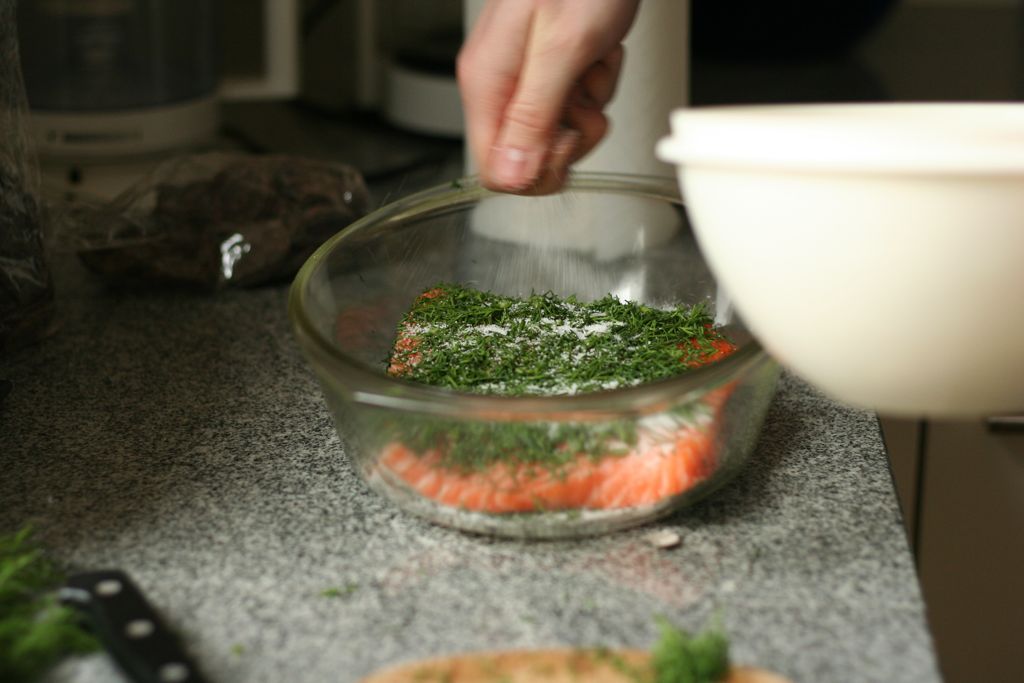
Mix salt, sugar and pepper. Cut the salmon into two equally large (geometrically, not weight-wise) pieces. Finely chop the dill, including stalks. In a dish large enough to accommodate the salmon, sprinkle the bottom with some of the salt-sugar-mix, and some of the dill. Place one piece of fish, skin-side down, on the mixture. Sprinkle nearly all of the mix and dill on the fish, and place the other piece on top, skin-side up. Cover with the last of the mixture and dill. Place some sort of surface on top, for instance a small cutting board or plate, and then place a milk carton or some other heavy item on top, to apply some pressure. Let sit for about 3 days, turning the filet-package upside down once during the time. The longer the fish cures, the more water will be extracted from it, and the firmer and less raw it will be. Three days is pretty much optimal. The fish will water lots during the curing; this is normal.
Once the fish has cured, pick it out, brush off most of the dill, and slice it very finely. Cured salmon is delicious on its own, with boiled potatoes, on toast, or on crisp bread. Always serve with hovmästarsås, recipe below.

Hovmästarsås
This sauce is traditionally served with cured salmon, but is great to any fat fish served cool. The name translates to "Head waiter's sauce" and is so named because it would be stirred together right at the table, by the waiter himself. Or so I'm told.
The dill, that lovely Nordic herb, shows up again here. Whenever there's fish in Sweden, there's likely to be dill around. The recipe calls for Swedish style sweet mustard. I know that you can find sweet mustard in Bavaria, but it might be hard to conjure up anywhere else. You could try using Dijon mustard instead, but reduce the amount to 1 Tbsp in that case, and probably add a bit of sugar.
Ingredients
2 Tbsp sugar
2 ml salt
6 Tbsp finely chopped dill
3 Tbsp sweet mustard
1 Tbsp red wine vinegar
100 ml neutral-tasting oil
fresh ground white pepper, salt
Instructions
Rub sugar, salt and dill in a mortar to bring out the dill flavours. Mix in mustard and vinegar. Add the oil in small doses, stirring vigorously (like a mayonnaise), until it's all incorporated. Season with salt and pepper to taste.
This year, being an expatriate in Munich, I couldn't just pop over to my parents' house for Easter, so Angelica and I had to try to create our own holiday spirit. It didn't look too bad at first, we Swedes have a trick up our sleeve to get the necessary food stuffs for holidays. Can you guess it? Picture the colours of the Swedish flag, navy blue and yellow. Now picture a huge-ass warehouse building painted in that blue colour, with yellow letters on it. I'm talking about IKEA, of course.
Telling someone that you're Swedish will usually result in one of three responses: 1) "Oh, with the chocolate and the mountains?" "No, I'm not from Switzerland", 2) "Oh, blonde girls with big breasts?" "Well... yeah, but...", or 3) "Oh... IKEA!". Frustrating as this can be, I am still happy that IKEA exists. As soon as I set my foot in that huge store, I immediately feel at home, and it is a great source of Leksands knäckebröd and pickled herring. With the crisp bread (knäckebröd), pickled herring and flavoured vodka (snaps) in place, disaster struck; there was still something missing: the cured salmon.
Munich is a quite land-locked city, with all of Germany between it and the Atlantic and Baltic Sea, and the Alps between it and the Mediterranean. Consequently, the poor people don't really have a culture of eating fish, and the prices of fresh fish reflect this fact. Shelling out €30 / kg for farmed salmon didn't exactly make me happy, I consider it to be well over twice a decent price for the fish, but Easter only comes once a year, and what can you do? Besides, the result was worth it.
Well, I'm getting on a bit, so let's move on to the recipe.
Gravad lax
The food authorities in Sweden recommend that you deep freeze your salmon for a couple of days before curing it. This is because the fish will be eaten uncooked (unheated), and apparently salmon can sometimes have parasites, presumably worms. Me, I'm brave; I eat fish raw without freezing, and as of today, I'm still alive. Your mileage may vary. The problem with freezing the fish is that it tends to become a bit watery and looses firmness, which has a negative impact on the cured product.
Speaking of fish quality, take a whiff at the filet before you buy it. If it smells faintly of the ocean, it's fresh. If it smells like fish, it's not fresh enough. Find another fishmonger.
This recipe is calculated for about 1 kg of filet, which was what I used, but you can cure enormous amounts at once, just scale it up. Curing less than 1 kg can be sort of tricky, since you need to double-layer the fish.
Ingredients
1 kg of fresh salmon filet, the fatter the better, and firm in texture
50 ml salt
60 ml sugar
1 tsp of coarsely crushed white pepper
a big bouquet of dill
Instructions
Mix salt, sugar and pepper. Cut the salmon into two equally large (geometrically, not weight-wise) pieces. Finely chop the dill, including stalks. In a dish large enough to accommodate the salmon, sprinkle the bottom with some of the salt-sugar-mix, and some of the dill. Place one piece of fish, skin-side down, on the mixture. Sprinkle nearly all of the mix and dill on the fish, and place the other piece on top, skin-side up. Cover with the last of the mixture and dill. Place some sort of surface on top, for instance a small cutting board or plate, and then place a milk carton or some other heavy item on top, to apply some pressure. Let sit for about 3 days, turning the filet-package upside down once during the time. The longer the fish cures, the more water will be extracted from it, and the firmer and less raw it will be. Three days is pretty much optimal. The fish will water lots during the curing; this is normal.
Once the fish has cured, pick it out, brush off most of the dill, and slice it very finely. Cured salmon is delicious on its own, with boiled potatoes, on toast, or on crisp bread. Always serve with hovmästarsås, recipe below.
Hovmästarsås
This sauce is traditionally served with cured salmon, but is great to any fat fish served cool. The name translates to "Head waiter's sauce" and is so named because it would be stirred together right at the table, by the waiter himself. Or so I'm told.
The dill, that lovely Nordic herb, shows up again here. Whenever there's fish in Sweden, there's likely to be dill around. The recipe calls for Swedish style sweet mustard. I know that you can find sweet mustard in Bavaria, but it might be hard to conjure up anywhere else. You could try using Dijon mustard instead, but reduce the amount to 1 Tbsp in that case, and probably add a bit of sugar.
Ingredients
2 Tbsp sugar
2 ml salt
6 Tbsp finely chopped dill
3 Tbsp sweet mustard
1 Tbsp red wine vinegar
100 ml neutral-tasting oil
fresh ground white pepper, salt
Instructions
Rub sugar, salt and dill in a mortar to bring out the dill flavours. Mix in mustard and vinegar. Add the oil in small doses, stirring vigorously (like a mayonnaise), until it's all incorporated. Season with salt and pepper to taste.
Subscribe to:
Posts (Atom)