Easter came, as it does once a year, and brought a whole new world of food-related trouble. In my family, Easter is a tradition-laden event, where the whole family would gather for an Easter smörgåsbord, that decadent Swedish specialty. My mother would serve up a range of traditional and untraditional dishes: the ubiquitous pickled herring (
inlagd sill), boiled eggs, cold meats and sausages, Västerbotten cheese pie, meat balls (
köttbullar), fresh baked bread, and more. But there is one dish that would somehow set itself apart from the other delicacies, and make itself king of the smörgåsbord. I am talking of
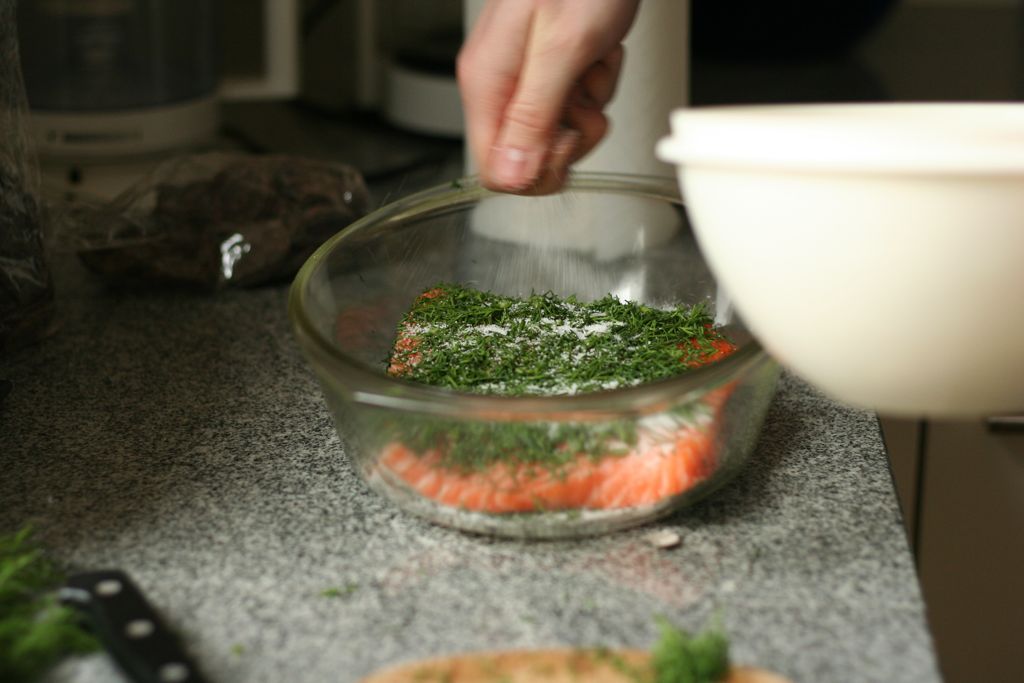
Gravad lax; salmon cured in salt, sugar and dill. Food does not get much more Nordic than this, and not much simpler either, if you have a couple of days to spare.

This year, being an expatriate in Munich, I couldn't just pop over to my parents' house for Easter, so Angelica and I had to try to create our own holiday spirit. It didn't look too bad at first, we Swedes have a trick up our sleeve to get the necessary food stuffs for holidays. Can you guess it? Picture the colours of the Swedish flag, navy blue and yellow. Now picture a huge-ass warehouse building painted in that blue colour, with yellow letters on it. I'm talking about IKEA, of course.
Telling someone that you're Swedish will usually result in one of three responses: 1) "Oh, with the chocolate and the mountains?"
"No, I'm not from Switzerland", 2) "Oh, blonde girls with big breasts?"
"Well... yeah, but...", or 3) "Oh... IKEA!". Frustrating as this can be, I am still happy that IKEA exists. As soon as I set my foot in that huge store, I immediately feel at home, and it is a great source of Leksands knäckebröd and pickled herring. With the crisp bread (
knäckebröd), pickled herring and flavoured vodka (
snaps) in place, disaster struck; there was still something missing: the cured salmon.
Munich is a quite land-locked city, with all of Germany between it and the Atlantic and Baltic Sea, and the Alps between it and the Mediterranean. Consequently, the poor people don't really have a culture of eating fish, and the prices of fresh fish reflect this fact. Shelling out €30 / kg for farmed salmon didn't exactly make me happy, I consider it to be well over twice a decent price for the fish, but Easter only comes once a year, and what can you do? Besides, the result was worth it.
Well, I'm getting on a bit, so let's move on to the recipe.
Gravad laxThe food authorities in Sweden recommend that you deep freeze your salmon for a couple of days before curing it. This is because the fish will be eaten uncooked (unheated), and apparently salmon can sometimes have parasites, presumably worms. Me, I'm brave; I eat fish raw without freezing, and as of today, I'm still alive. Your mileage may vary. The problem with freezing the fish is that it tends to become a bit watery and looses firmness, which has a negative impact on the cured product.
Speaking of fish quality, take a whiff at the filet before you buy it. If it smells faintly of the ocean, it's fresh. If it smells like fish, it's not fresh enough. Find another fishmonger.
This recipe is calculated for about 1 kg of filet, which was what I used, but you can cure enormous amounts at once, just scale it up. Curing less than 1 kg can be sort of tricky, since you need to double-layer the fish.
Ingredients1 kg of fresh salmon filet, the fatter the better, and firm in texture
50 ml salt
60 ml sugar
1 tsp of coarsely crushed white pepper
a big bouquet of dill
 Instructions
Mix salt, sugar and pepper. Cut the salmon into two equally large (geometrically, not weight-wise) pieces. Finely chop the dill, including stalks. In a dish large enough to accommodate the salmon, sprinkle the bottom with some of the salt-sugar-mix, and some of the dill. Place one piece of fish, skin-side down, on the mixture. Sprinkle nearly all of the mix and dill on the fish, and place the other piece on top, skin-side up. Cover with the last of the mixture and dill. Place some sort of surface on top, for instance a small cutting board or plate, and then place a milk carton or some other heavy item on top, to apply some pressure. Let sit for about 3 days, turning the filet-package upside down once during the time. The longer the fish cures, the more water will be extracted from it, and the firmer and less raw it will be. Three days is pretty much optimal. The fish will water lots during the curing; this is normal.
Once the fish has cured, pick it out, brush off most of the dill, and slice it very finely. Cured salmon is delicious on its own, with boiled potatoes, on toast, or on crisp bread. Always serve with
hovmästarsås, recipe below.
 Hovmästarsås
This sauce is traditionally served with cured salmon, but is great to any fat fish served cool. The name translates to "Head waiter's sauce" and is so named because it would be stirred together right at the table, by the waiter himself. Or so I'm told.
The dill, that lovely Nordic herb, shows up again here. Whenever there's fish in Sweden, there's likely to be dill around. The recipe calls for Swedish style sweet mustard. I know that you can find sweet mustard in Bavaria, but it might be hard to conjure up anywhere else. You could try using Dijon mustard instead, but reduce the amount to 1 Tbsp in that case, and probably add a bit of sugar.
Ingredients2 Tbsp sugar
2 ml salt
6 Tbsp finely chopped dill
3 Tbsp sweet mustard
1 Tbsp red wine vinegar
100 ml neutral-tasting oil
fresh ground white pepper, salt
InstructionsRub sugar, salt and dill in a mortar to bring out the dill flavours. Mix in mustard and vinegar. Add the oil in small doses, stirring vigorously (like a mayonnaise), until it's all incorporated. Season with salt and pepper to taste.